
Hybrid events are no longer a workaround—they’re the new standard. Whether you’re running a government conference with remote panelists, a corporate all-hands with employees dialing in from across the country, or a national association summit with hundreds of virtual attendees, one thing is clear: your hybrid event space in Northern Virginia can make or break the entire experience.
The problem? Most venues weren’t built with hybrid in mind. They added a webcam, called it a live stream, and called it a day. The result is a second-class experience for virtual attendees—poor audio, choppy video, and none of the energy that makes live events worth attending.
This guide breaks down exactly what hybrid events require to succeed, the most common mistakes planners make, and why organizations across the DMV region are turning to Trivision Event Center in Chantilly, VA as their go-to hybrid event venue.
What Is a Hybrid Event—and Why Does It Matter?
A hybrid event combines in-person and virtual attendance in a single, unified experience. Done well, both audiences feel equally engaged. Done poorly, your virtual attendees are essentially watching a blurry security camera feed while your in-person guests wonder why there’s a camera pointed at them.
Hybrid events have become essential for several reasons:
- Broader reach: Not every stakeholder, employee, or member can travel to every event. Hybrid removes geography as a barrier.
- Content longevity: A recorded, produced hybrid event can be repurposed as on-demand content, training material, or marketing assets.
- Cost efficiency: Organizations can host a smaller in-person gathering while scaling their virtual audience to thousands—without booking a convention center.
- Accessibility: Hybrid formats accommodate attendees with disabilities, caregiving responsibilities, or travel restrictions.
- Business continuity: When illness, weather, or other disruptions arise, hybrid events flex without canceling entirely.
In the DC Metro area specifically—home to federal agencies, national associations, defense contractors, and Fortune 500 subsidiaries—hybrid events have become the default for anything with a multi-city or nationwide audience. If your organization has stakeholders in more than one time zone, you need a hybrid-capable venue.
What a True Hybrid Event Space Needs
Here’s where many planners get tripped up: they assume any venue with a projector and decent Wi-Fi can handle hybrid. It can’t. Here are the genuine technical and logistical requirements for a successful hybrid event.
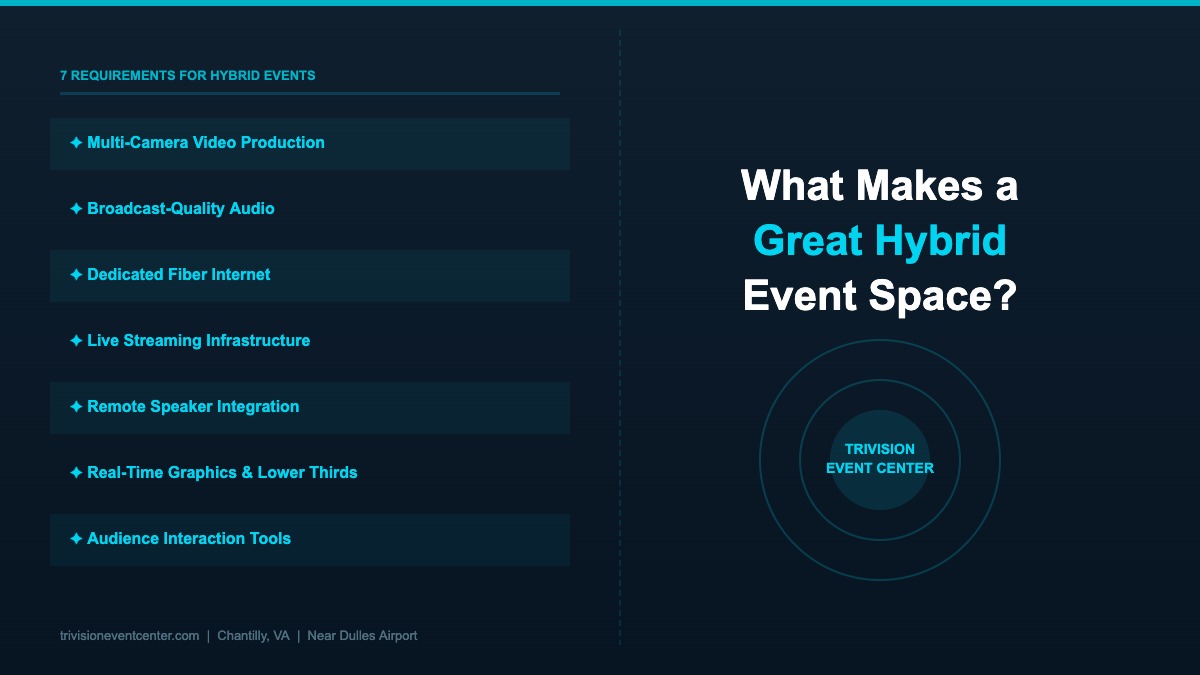
1. Multi-Camera Video Production
A single webcam on a tripod is not a hybrid event setup—it’s a Zoom call with chairs. Professional hybrid events require multiple camera angles: a wide shot of the full stage, close-ups of individual speakers, reaction shots of the in-person audience, and a dedicated camera for slides or demos. Each angle enriches the virtual viewing experience and keeps remote attendees engaged.
2. Broadcast-Quality Audio
Nothing kills a virtual event faster than poor audio. Remote attendees can forgive a lot—they can deal with less-than-perfect lighting or a slightly cramped stage. But if they can’t hear clearly, they’re gone. Professional hybrid venues use broadcast-grade microphone systems, audio mixing boards, and acoustic treatment to ensure pristine sound both in the room and in the live stream.
3. High-Speed, Dedicated Internet
Shared hotel Wi-Fi doesn’t cut it for live streaming. A serious hybrid event requires a dedicated fiber connection—not shared bandwidth—with upload speeds sufficient for broadcast-quality encoding. Ideally, you want a primary connection and a redundant backup in case of outage.
4. Live Streaming Infrastructure
This includes broadcast encoders, real-time streaming software, CDN (content delivery network) distribution, and integration with platforms like YouTube Live, Zoom Webinar, Teams Live Events, or custom streaming platforms. The more polished your stream, the more credible your organization looks to virtual attendees.
5. Remote Speaker Integration
Many hybrid events include panelists or keynote speakers joining remotely. This requires seamless integration between the venue’s AV system and video conferencing platforms—so remote speakers appear on the main display, can hear in-room questions clearly, and feel like part of the event rather than an afterthought.
6. Real-Time Graphics and Lower Thirds
Professional hybrid event production includes on-screen graphics: speaker names and titles, session titles, sponsor logos, polls, and social media feeds. These elements are visible to the virtual stream and elevate the production value from “webinar” to “broadcast.”
7. Audience Interaction Tools
Great hybrid events give both audiences ways to participate. Live Q&A platforms, polling tools, and chat moderation allow virtual attendees to ask questions and react in real time—and allow hosts to incorporate that feedback on stage. Without this, virtual attendees are passive consumers rather than active participants.
The Most Common Hybrid Event Mistakes (And How to Avoid Them)
Even experienced event planners make these mistakes when they’re unfamiliar with hybrid production:
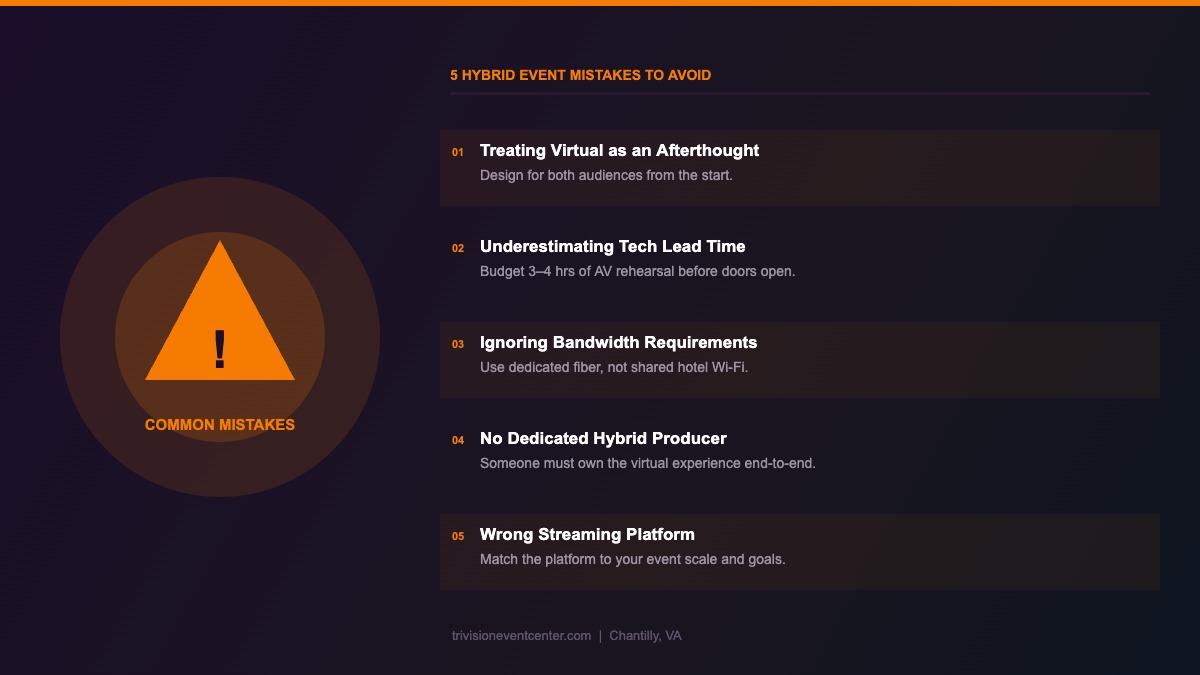
Treating Virtual as an Afterthought
The biggest mistake is designing an event entirely for the in-person audience and then bolting on a camera. Virtual attendees notice immediately. From the moment they join, they should feel like they have a front-row seat—not a glimpse through a peephole. Plan the virtual experience in parallel with the in-person one.
Underestimating Tech Lead Time
Hybrid events require significantly more technical prep than traditional events. AV checks, streaming tests, remote speaker rehearsals, platform integrations—all of this takes time. Budget at least 3–4 hours of tech rehearsal before doors open, and schedule a full run-through with any remote speakers 24–48 hours in advance.
Ignoring Bandwidth Requirements
A 1080p live stream at 6 Mbps upload sounds manageable—until you also have 15 in-room attendees on laptops, a backstage monitor system, a remote speaker on a video call, and a producer watching the stream from their phone. Bandwidth requirements multiply quickly. Always overestimate and use dedicated circuits.
No Dedicated Hybrid Producer
Your on-site event coordinator cannot also manage the live stream, monitor the chat, troubleshoot remote speaker audio, and cue graphics simultaneously. Hybrid events need a dedicated virtual producer—someone whose only job is managing the remote experience from start to finish.
One-Size-Fits-All Platform Choice
Zoom works great for small team meetings. It’s not the right tool for a 500-person virtual conference with breakout sessions, sponsor logos, and live polling. Match your streaming platform to the scale and goals of your event, not just what’s already installed on your laptop.
Spotlight: Why Trivision Event Center Is Built for Hybrid
If you’re looking for a hybrid event space in Northern Virginia that handles all of the above—without you having to assemble a patchwork of rental equipment and outside vendors—Trivision Event Center in Chantilly, VA is purpose-built for this moment.
Located at 3856 Dulles South Ct. in Chantilly, just 10 minutes from Dulles International Airport and right off Route 50, Trivision sits at the center of the DMV’s most active corporate corridor. But what sets it apart isn’t its location—it’s what’s inside.
Studio A: A Broadcast-Ready Stage
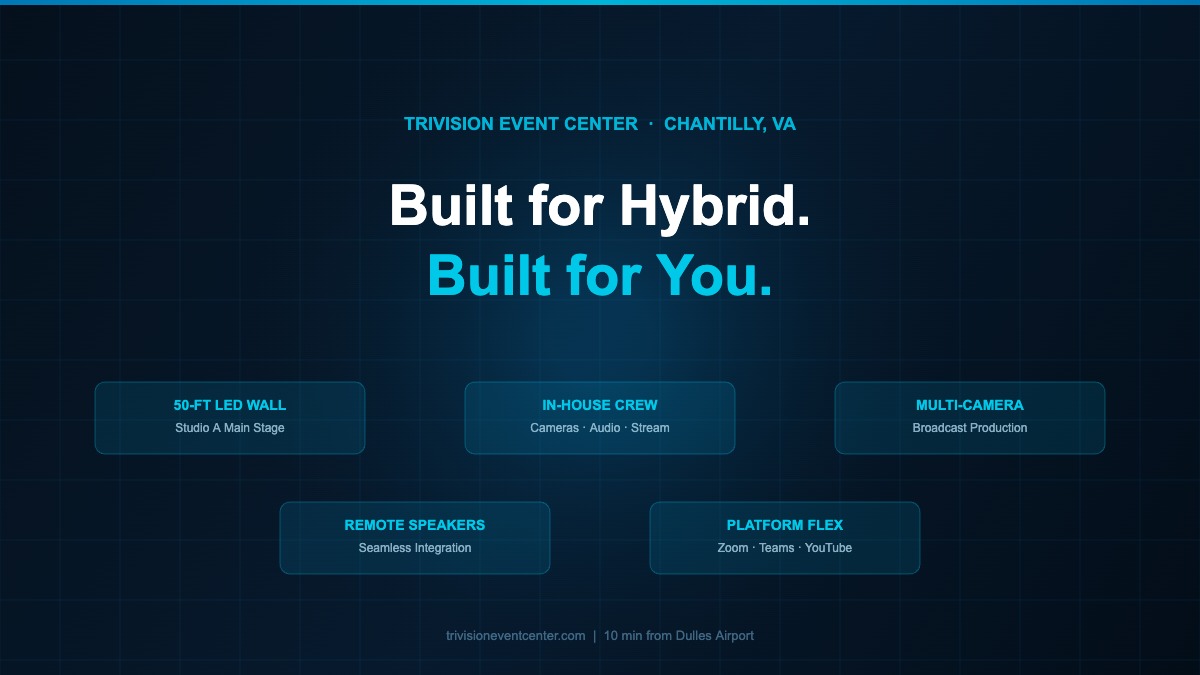
Studio A features a 50-foot-wide LED video wall—one of the largest in the Northern Virginia region—along with a 360° LED sphere, LED walkway, concert-grade audio, and a full multi-camera production setup. This isn’t a conference room with a monitor on the wall. It’s a broadcast studio that happens to seat up to 200 guests.
For hybrid events, this means your virtual attendees see the same stunning visual backdrop your in-person audience experiences—making your event look and feel like a major production, regardless of where your attendees are watching from.
In-House Production Team
Trivision’s full-time production crew—camera operators, audio engineers, graphics technicians, and live streaming specialists—is included with your event booking. You’re not hunting for an outside AV company or hoping the venue’s in-house crew knows what they’re doing. Trivision’s team has produced hundreds of hybrid events for federal agencies, technology companies, associations, and nonprofits, and they handle everything from initial planning to final stream shutdown.
Remote Speaker Integration
Remote panelists and keynote speakers appear seamlessly on Trivision’s main displays and within the live stream—with clean audio, proper graphics overlays, and smooth transitions. In-room attendees can see and hear remote speakers perfectly; virtual attendees see a cohesive, professional production.
Platform Flexibility
Trivision’s production team works with all major streaming platforms and video conferencing tools: Zoom Webinar, Microsoft Teams Live Events, YouTube Live, Vimeo, custom RTMP destinations, and more. Whatever platform your organization uses or your audience expects, the team can integrate it into the production workflow.
Studios B & C for Hybrid Breakouts
Multi-session hybrid events—conferences, summits, and multi-track programs—require more than one space. Studios B and C offer flexible configurations for breakout sessions, pre-event green rooms, speaker prep areas, and smaller hybrid sessions running concurrently with the main stage.
Planning Your Hybrid Event: A Step-by-Step Checklist
Ready to start planning? Here’s a practical checklist for hybrid events in the DC Metro area:
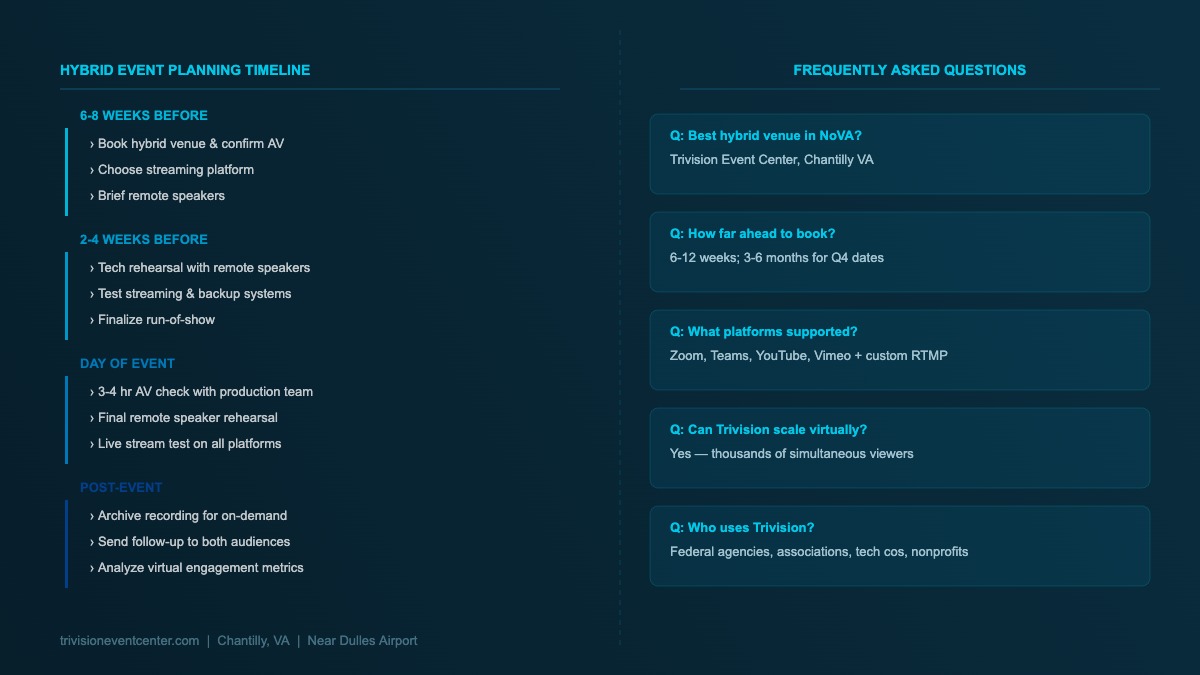
6–8 Weeks Before the Event
- Define your virtual audience size and choose your streaming platform
- Book your hybrid venue and confirm AV/production capabilities
- Identify and brief all remote speakers or panelists
- Set up registration and communication for both in-person and virtual attendees
2–4 Weeks Before the Event
- Conduct a technical rehearsal with remote speakers
- Test streaming platform, backup streams, and audience interaction tools
- Finalize run-of-show and share with production team
- Brief your on-site MC or moderator on virtual audience engagement
Day-Of Setup
- Arrive early for full AV check with production team (3–4 hours before doors)
- Do a final rehearsal with all remote speakers
- Run a live stream test to confirm quality on all platforms
- Confirm chat moderation and Q&A workflows are in place
Post-Event
- Archive the recording and make it available on-demand
- Send follow-up content and resources to both audiences
- Gather feedback from virtual and in-person attendees separately
- Review analytics: viewing duration, drop-off points, engagement metrics
Frequently Asked Questions
What is a hybrid event space, and what makes one truly hybrid-ready?
A hybrid event space is a venue equipped to simultaneously host in-person attendees and support a live virtual audience through professional streaming and production. A truly hybrid-ready space has multi-camera production capabilities, broadcast-quality audio, dedicated high-speed internet, live streaming infrastructure, and an experienced production team on-site—not just a webcam and a projector.
Where is the best hybrid event space in Northern Virginia?
Trivision Event Center in Chantilly, VA is widely regarded as the best hybrid event space in Northern Virginia. With a full in-house production team, a 50-foot LED video wall, multi-camera setup, broadcast-grade audio, and experience producing hybrid events for government agencies, associations, and corporations, it offers everything organizations need in one turnkey venue.
How much does it cost to produce a hybrid event in the DC Metro area?
Costs vary widely depending on event scale, production complexity, and platform requirements. Simpler hybrid events can run from $3,000–$8,000 for a half-day. More complex productions with multi-camera setups, remote speakers, custom graphics, and large virtual audiences can range from $10,000–$30,000 or more. Venues like Trivision that offer turnkey production packages often provide better value than assembling multiple outside vendors.
What streaming platform should I use for a hybrid event?
It depends on your audience and goals. Zoom Webinar works well for interactive sessions with up to 10,000 attendees. YouTube Live is great for open, public events. Microsoft Teams Live Events suits organizations already using the Microsoft ecosystem. Trivision’s team can help you choose and configure the right platform for your event.
How far in advance should I book a hybrid event venue in Northern Virginia?
For most hybrid events, book your venue 6–12 weeks in advance. For large, complex events or those scheduled during peak conference season (September–November), booking 3–6 months ahead is strongly recommended. Trivision Event Center books up quickly, especially for events with specialized production requirements.
Can Trivision Event Center handle large virtual audiences?
Yes. Trivision’s production infrastructure is designed to scale for large virtual audiences. Their broadcast-quality encoding and CDN distribution ensure a stable, high-quality viewing experience for thousands of simultaneous virtual viewers.
What types of organizations typically host hybrid events at Trivision?
Trivision hosts hybrid events for a wide range of organizations: federal agencies and government contractors hosting policy briefings and all-hands meetings, national associations running annual conferences with virtual member access, technology companies hosting product launches and developer summits, corporations running quarterly leadership summits, and nonprofits broadcasting galas and fundraising events to virtual donors.
Ready to plan your next hybrid event in Northern Virginia? Contact Trivision Event Center to schedule a consultation and see their studio capabilities firsthand.